An often updated video game review blog. Reviews encompass all major consoles and portable gaming handhelds.
Tuesday, April 5, 2011
Rush n' Attack: Ex-Patriot Review (XBOX Live Arcade Version)
It's the dead of the Russian winter, and you're tasked with infiltrating a secret military compound. Your goal? To try to save a member of your team who is imprisoned on the grounds, and has been for fifteen years - ever since he was first sent in during the Cold War. The secondary goal is to make sure that the Russians haven't been working on a new missile program, without the rest of the world knowing. If so, do whatever you can to sabotage the experiment before it becomes a threat to the United States and, eventually the rest of the world. If you choose to accept this mission, then it's you without any support. Interested, soldier?
Developed in the Czech Republic by Vatra Games and published by Konami, Rush n' Attack: Ex-Patriot is a sequel to the popular 1985 Nintendo game, Rush n' Attack. It's a downloadable action game, which sends players into hostile Russian territory with little more than a knife and the clothes on their back. It seems that Russian miners found a formerly unknown material known as ulyssium, which they've used to develop powerful nuclear missiles. You're the only person who can put an end to it and save your former ally before it's too late. Being the only man inside enemy lines, means that your main task is to complete your objectives without causing too much attention. Due to that, stealth plays a bit part within the experience.
The action within Rush n' Attack takes place in side-scrolling fashion, as gamers look at the world in 2.5D. It is structured a lot like Shadow Complex, where each level is a 2D maze, filled with tons of hidden areas. Players must work their way from one end of the levels to another, completing objectives along the way, such as finding bombs, destroying nukes and freeing prisoners. Instead of being gun heavy like most games of this type, Vatra Games decided to make it more of a melee combat centric experience. Due to this, the main character (Sargeant Sid Morrow - call sign, Wolf Spider,) predominantly utilizes a knife to take out his opponents. Though guns are picked up at certain points of the game, they usually have a very small amount of ammunition and can only be used for a brief amount of time because of that.
Although the original game it succeeds was a very fast-paced action game, Ex-Patriot features a slower pace with much more methodical gameplay. Each of the game's three lengthy missions takes place in a different part of the base, where gamers must utilize stealth to try to take out enemies without being noticed. Becoming noticed doesn't mean it's game over, but you don't earn as many points for taking guys out in open conflict. The scoring system awards stealth kills with the highest amount of points possible, and it's important to complete as many as you can if you ever hope to earn an S rating on each level. Stealth kills also make the game a lot easier, as they are on hit kills. You can perform them with either X or Y, with the former being used for light attacks and the latter for slower/stronger attacks.
Players can run and slash their way through the game if they'd like, but it's quite tough, especially on veteran difficulty. Enemies are challenging to fight as they block a lot, with a lot of them holding powerful weaponry. It's your choice, but keeping to the shadows and planning surprise attacks from sunken doorways, ceiling hiding spots and other hidden areas is recommended. Of course, there are three different difficulties available, with the option to choose easy, medium or hard. Hard is required to earn an S-rating, however. You're also graded based on your completion time, as each mission has a par time that must be achieved in order to get a good rating. Boss battles take place at the end of each mission, and they can take a little while. The first two are well-designed, but the last one was unfortunately very poor.
Extra-curricular exploration is rewarded through the in-game scoring system (and an achievement,) if you are able to find each of the 36 ulyssium crystals hidden throughout the campaign. There are twelve to be found in each mission, so a lot of your time will be spent scouring air vents and tiny crevices in order to try to find every single one of the blue, glowing crystal formations. Unfortunately, in an odd and frustrating design choice, the crystals that you find are only linked to one playthrough. This means that you must find them all in one run to get the achievement. There is no opportunity to go back and play the missions again with your collectible statistics, despite the fact that the game features a level select option. This was discovered after finding 35/36 of them. Most of the time though, they're quite easy to find, although some require valiant exploration.
In addition to its exploration, stealth and combat, the game also features some basic switch puzzles. Sometimes you will need to flick a couple of switches to lower radioactive fluids in a room, so that you can get progress. Other times, you'll need to use switches to open doorways, or find key cards that will open them for you. The puzzles aren't anything to write home about and never push the envelope, but they make you explore the world a lot. Sometimes the use of a gas mask or night vision goggles will be required, though they're quite easy to come by. You only need to pick them up once, but can find them in several places as you make your way through the levels.
The game's campaign is quite lengthy, with its three missions lasting more than one hour - with two hours being the average, experienced on veteran difficulty. The maps are quite large and there is a lot to do that will keep you busy for quite a while. Plus, there are some really challenging sections. Its combat system works pretty well, but there are times where the controls aren't as precise as they could have been, allowing for input lag during the odd block attempt. The game's structure and core gameplay are quite generic, but there is some fun to be had, despite repetitive gameplay. The problem is that it never evolves at all, so you're doing the same things over and over again, only with the ability to use a couple more gadgets at the end of the game. It would have been nice if there was more variety to the experience, and a more fleshed out combat system, because most encounters boil down to pressing X or Y to attack a few times, blocking, and then repeating that. There are several combos that you can use if you feel like it.
Rush n' Attack: Ex-Patriot looks pretty good, with detailed environments and relatively shiny visuals. Though there is a noticeable lack of variety within the locations, leaving most areas within the game looking quite similar and dull. The game's character models are reminiscent of those found in the Bionic Commando: Re-Armed games, as most of the time you're just up against basic enemies who look identical. Each character model looks okay and animates pretty well, but there's nothing unique or memorable about them. Though it looks quite basic, it also looks impressive in some ways. The only two cutscenes to be found are at the beginning and end of the game, and are hand-drawn in a comic style. They were pretty well done, and it would have been nice to have seen more of them.
Ex-Patriot's sound is another mixed bag. Since a lot of the game relies on stealth, audio isn't an overly prevalent aspect. There is an original score that sounds decent, but silence is used quite often, and is relatively effective in setting the mood for the type of game that it is. The sound effects work is generally pretty good, with quite a few of them utilized, however there are some that can become grating. The most annoying one would be the old-school death grunt that occurs when your main character is taken out in battle. It got quite annoying after a while. Most of the time, you'll hear your knife hitting the enemies' metal claws, gunfire or explosions. Sometimes alarms as well, as you can be spotted by security cameras, which will close down the area you're in, allowing multiple enemies to come at you at once.
The game's storyline is particularly macho, and is told through the use of dialogue screens. The two conversing characters' images are shown, with dialogue bubbles stretching out beside them. This is a missed opportunity because it's incredibly generic and takes players out of the experience. One of the weirdest things about it is the fact that, if you press A to progress the conversation, it will skip to the next character's bubble instead of skipping to the end of the current dialogue bubble. Most games allow you to press A to fast-forward scrolling text, but this is something new. If you press A to skip through something during a conversation scene, the only way you'll be able to read what was said during the skipped dialogue is to squint to see the muted gray tones that the text has been reduced to in the background. Only the current dialogue that is being spoken is shown in full black.
Overall, Rush n' Attack: Ex-Patriot is a mediocre experience. There is a lot of potential that wasn't realized within the game design, and the experience is quite mediocre overall. Though, despite its issues, Rush n' Attack isn't a bad game - it's just one that doesn't push the envelope at all. There is nothing memorable or exciting about the game, when it's compared to other games within its genre, though most of its mechanics work pretty well, apart from the terrible final boss fight. If you're looking for something new to play and you like this type of game, then it's worth trying. However, it's not for everyone, despite its moderate price tag.
Rating: 5.5/10
Rush n' Attack: Ex-Patriot was released on March 30th for XBOX Live Arcade. It is also available on the PlayStation Network. The price tag comes in at 800 Microsoft Points or ten American dollars.
Monday, April 4, 2011
The Dishwasher: Vampire Smile Review (XBOX Live Arcade Game)
Two years ago, independent game developer James Silva, released a creative hack n' slash Arcade game known as The Dishwasher. It was released to a great reception from both fans and reviewers. Fast-forward a couple of years and XBOX Live Arcade is once again going to be full of dismembered body parts, gallons of blood and angry samurai. In fact, there are two of them this time around. Once you insert the entry fee, prepare to go on a wild ride as you fight for answers to a series of twisted nightmares, leaving piles of body parts along the way. Just make sure there aren't any kids around because, needless to say, this is one of the most violent games out there.
Taking place after the events in the first game, The Dishwasher: Vampire Smile sees our titular hero and his sister reliving events from their past. Players can choose to play the campaign as either character, with each one having its own campaign. The game begins by showing Yuki experiencing some very intense nightmares, which catapults players into a quest to find out who is responsible for the nightmarish hallucinations. Along the way, Yuki and her brother are haunted by moments from the past, encountering 'marks' (important targets) along the way, who Yuki feels must be taken out. Battle your way through a myriad of different (and creative) environments, as you work towards obtaining the truth behind Yuki and her disturbing nightmares. The story is focused on Yuki more so than her brother, so make sure to play through her campaign first. The Dishwasher's campaign is an alternate version of events that takes place in many of the same locations, as he discovers what his sister is doing.
The Dishwasher was well-known for its fast-paced, but difficult, visceral hack n' slash combat. This sequel is the same type of experience, with incredibly fast-packed combat allowing for vicious combos and a million dismembered bodies left in your wake. As you progress through the game, you're tasked with utilizing various different types of weapons (such as swords, a large needle and a pair of scissors,) to take out tons of enemies who get in your way. Two separate loadouts can be created for each character, and the ability to switch between weapons is made easy by the use of the controller's two shoulder buttons.
Each of the two characters has their own weapons that can be discovered along the way, including different types of creative melee weapons and firearms. Each weapon has its own benefits and drawbacks, based on different damage, speed and weight stats. Yuki's weapons are generally smaller than her brother's, allowing her to constantly be able to blood teleport, while her brother can only do it when he is not holding a heavy weapon such as a gigantic hammer. Yuki also carries a chainsaw, whereas that weapon is absent from the Dishwasher's arsenal, allowing for him to have a dash attack instead. The aforementioned blood teleportation move allows you to quickly teleport around the environment (including teleporting up to the ceiling quickly) by the use of the right joystick. It's very helpful in combat and can allow you to keep combos going, teleport through gates and avoid attacks from dangerous foes.
As you progress through the game's two campaigns (which took between three and four hours to complete,) different types of dish magic will also become available for use. Each type of magic is assigned to one of the controller's four main buttons, allowing for easy use (once you've held down the required trigger button.) These four different types of magic include spirit magic that will heal you with the life essence of enemies, blade magic that sends out a bunch of swords that attack enemies, and a type of lightning magic that electrocutes nearby foes. Magic is available for use only when you have a magic skull, which is earned by defeating certain enemies in battle or eating a certain type of food. Players can add more skulls to their arsenal, by purchasing the increase through the in-game store. This is also where other items (such as health replenishing food,) and upgrades are available for purchase. Luckily, these upgrades carry over into your second campaign.
For those who may be scared of the game due to the insanely difficult campaign that its predecessor is known for having, there's no need to worry. After listening to the issues that some gamers had with the original's challenge, James Silva has added several different difficulty types, ranging from the unlockable Pretty Princess difficulty to an extremely difficult one. Heck, there's even a speed run difficulty. Playing through the campaign (twice) on normal was a decent challenge, but wasn't frustratingly difficult. It's nice to see that the developer listened to his fans and made the game more accessible for all gamers, whose skills vary.
In addition to the two campaigns, Vampire Smile also includes two other modes: Arcade Mode and Dish Trial. The Arcade Mode features 50 different challenges, which pit you against varying amounts of foes from the campaign. You are tasked with clearing out the level without failing. Conversely, the Dish Trial pits you against an endless onslaught of enemies with just one life. These modes add a lot of extra content to an already lengthy experience. Replay value is very high not only within these modes but also within the campaign. Multiplayer is also available, allowing for people to play with their friends and challenge their top scores in the in-game leaderboards. Both of those were down during the review session.
Its campaign and bonus features were very impressive. Vampire Smile runs extremely well (with only a couple minor framerate hiccups discovered while playing as the Dishwasher,) which is impressive considering how fast-paced the game is. Rarely do we see such a creative experience that is as finely-tuned and well-made as this. Though everything about it is incredibly stylized, there is also a lot of substance to complement it. The gameplay doesn't evolve a lot, but it's a lot of fun and doesn't become a chore due to repetition. One of the best features is the great amount of creativity that is employed in the enemy types, especially within the different types of bosses that players encounter along the way. The game also switches its style to 2D side-sidscroller with 8-bit zombie enemies, as well as a quiz show, at certain points. Fans will also be happy to know that the timed button press guitar solo sections also make a return.
James Silva and Ska-Studios employ one of the most creative and easily identifiable art styles within their games. So much so that it's always easy to tell which games he has worked on. Like its predecessor and the great Indie Game, I Made a Game With Zombies, Vampire Smile features a hand-drawn art style that utilizes muted tones with hints of colours. The art style is very reminiscent of a charcoal drawing and looks great. All of the characters animate well, but in a stylized fashion. There is a lot of blood spilled over the course of the campaign, with the odd drop hitting the screen. Overall, this is one of the most unique looking games out there. It's impressive to think that just one guy animated and coded the game.
Without very much voice acting, most of the game's story is told through the use of short comic panels with text bubbles. It works quite well for a game like this and the lack of voice acting did not detract from the experience at all. Vampire Smile makes good use of silence as well as sound, providing a good mixture of the two. Its original score sounds great, featuring some creepy rock music. Additionally, there are a myriad of different sound effects which fit in well, and sound great. The general quality of the audio is another impressive feature of this game. One of many in fact, showing just how much of a passion project this game really was.
In conclusion, The Dishwasher: Vampire Smile is a gem. Fans of its predecessor and Ska-Studios will surely be impressed with the new additions, as well as the game's other impressive new content. Those who are new to the series will be able to pick up and play the game, so there's no reason to fear jumping into this game without having played its predecessor. The campaigns reference the events of the first game, but also do a pretty good job of having their own storyline. If you're looking for something new to play and enjoy hack n' slash games of this ilk, then this is a must-buy. The Dishwasher: Vampire Smile is a very well-made experience that is very fun, despite somewhat repetitive gameplay. Luckily, its unique variety of weapons helps break up the repetition by allowing for new ways to take out your foes. Give it a shot and thank me later.
Rating: 9.5/10
The Dishwasher: Vampire Smile is available this Wednesday (April 6, 2011,) on XBOX Live Arcade. It is going to sell for 800 Microsoft Points - the equivalent of ten American dollars.
Thursday, March 31, 2011
Swarm Review (XBOX Live Arcade Version)
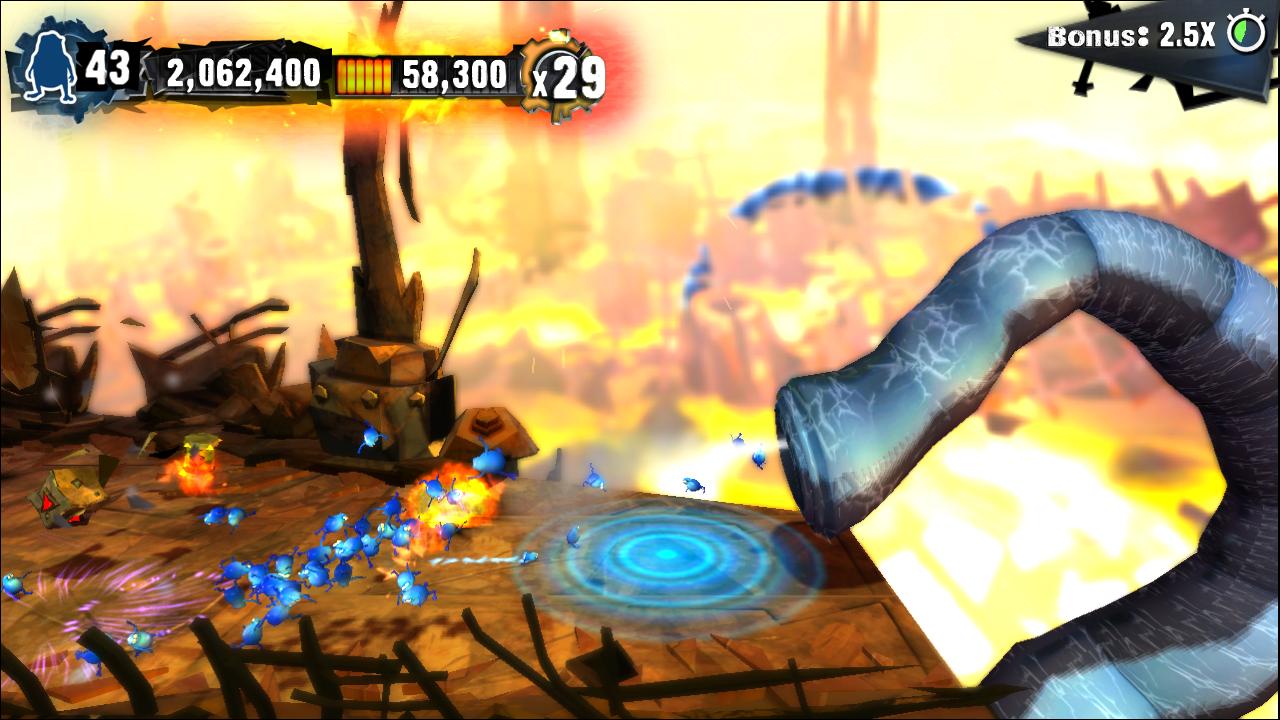
Take control of up to 50 masochistic little blue creatures and try to earn enough points to feed Momma. That sentence sums up the premise behind Swarm, a recent downloadable release from developer Hothead Games. To get an idea of what the game is like, think of a more violent and backwards version of Pikmin, where you're not only rewarded for completing puzzles and getting to the end of each level, but also sacrificing members of your swarm along the way. If this new approach to a seldom-visited puzzle game genre sounds interesting to you, then this may be something you'd enjoy. After all, Momma needs to be fed and it's up to us gamers to do so. Just be warned that the ride isn't always smooth - there are some rocks along the way.
Swarm is a game that doesn't focus much on providing an in-depth storyline. All that players are told is that you must earn enough points to feed the hive mother (Momma) so that she can grow and open up new areas to explore within the game world. It's a very basic premise, but it fits the game well. It would have been nice if there was a bit of a back story about the blue creatures (referred to as 'Swarmites,') and their hive, but the game doesn't suffer from its lack of explanation. The basic premise is enough to go on and all it really is there for is a reason for the game's masochistic content. Feed Momma enough and she'll let you progress. It's simple enough and easy to grasp.
If you've ever played Pikmin before, then you'll be familiar with this type of game, which also has some things in common with the Lemmings series. In each of the game's ten levels (plus two boss fights,) players lead a group of 50 (or less) Swarmites as they try to gather enough nutrients for their hive mother. This is done by picking up purple or red collectible ions, as well as DNA strands (five of which are hidden in each level.) The coloured ions can be found strewn throughout the level but are also found in explosive boxes and through the activation of timed switches. In order to earn the necessary amount of points that are required to progress to the next level, players must try to time their collecting to earn multipliers. Each new ion you earn adds to your multiplier, and most levels are easy to fail unless you get a high multiplier going at least once during your run. Luckily, you'll be able to keep your multipliers going even when you can't find any ions or DNA strands, just by sacrificing your minions. It's a really interesting and helpful design choice/twist, and the game rewards you well for it. The smaller the amount of Swarmites you're in control of when you get to each checkpoint, the higher the bonus you receive will be.
As you progress through each level, your Swarmites learn new abilities. These abilities vary from a charged attack that can take out crates and assist in jumping to far away platforms, to the ability to form a tower with the blue creatures. Players are also introduced to the fact that they can spread out their swarmites or draw them closer together, using the left and right triggers on the XBOX 360 controller. Every new ability can be used to assist in solving puzzles, towards the goal of earning the maximum amount of points possible in each level. In order to pick-up some of the hidden DNA strands, you will need to use these special abilities. I was happy to discover that, once I picked up a DNA strand, I didn't have to pick it up again if I lost all of my swarmites. Each of these new moves is relatively easy to use, though I did find that too many moves were mapped to the trigger buttons. I also noticed that the controls weren't as precise as they could have been. Though it's not a game breaking issue by any means, it was a tad annoying at times.
Though what I just described may sound easy, believe me when I say it isn't. Each level is full of different traps, environmental hazards and even some dangerous elemental enemies. Progression alone is a challenging feat sometimes, but coupling that with the game's high score requirements creates quite a (hectic) challenge. Split second decisions are required a lot of the time, as you decide whether it's more important to keep a high amount of the suicidal blue minions in your pack for tough obstacles ahead, or whether you can spare a few to keep your score multiplier going. It's very easy to make the wrong decision, though the game doesn't beat you down for failing. Checkpoints are quite frequent and, when you lose your last Swarmite, you respawn at the last checkpoint you passed with a full group of 50 tiny blue guys. Sometimes this can even be a tactic that can be used if you've missed a collectible DNA strand or a pressure sensitive pad, close to the checkpoint. Though you will lose your multiplier if all of your Swarmites are eliminated and that can be annoying in itself, especially if you're on a roll. Players are continually rewarded for the varying types of deaths they inflict on their minions, through a scoring system known as death medals. These medals come in varying types such as incineration and electrocution, and can be leveled up from lower metals to gold over time.
Swarm's mixture of action and puzzle elements works quite well, with some smart design choices evident throughout the game. I was impressed with how each level was designed to allow for a myriad of different scores, depending on your play style and your luck (which can factor in quite a bit at times.) If you go through without worrying about timing and multipliers, it's likely that you'll get to the end of the level without enough points to carry onward. Though, if you have a pretty good run, you're likely to succeed. Those who are good at these types of games will appreciate the ability to earn insanely high scores through the smart utilization of Swarmite sacrifices and score multipliers. I was in the middle, earning some decent scores, but finding some sections tough to complete because I wasn't getting great multipliers. A lot of trial and error was required on my end, but I always felt that it was my fault I wasn't able to proceed at those times, and not a terribly frustrating design choice implemented by the developers. That's definitely a good thing when it comes to these types of games.
The experience is not without its flaws, however. There are some minor issues including the fact that the game can become quite repetitive, is overly-dark and can sometimes become frustrating when it causes you to lose score after checkpoints reload. However minor, they do affect gameplay at times and will bother some people more than others. Unfortunately, there is also a major glitch that annoyed me to no end, where the game will freeze at its level select screen. This morning, I played Swarm for approximately 2 hours and it froze on me three times. The other day, it froze on me once at the same menu. Hopefully Hothead Games will patch this glitch quickly because it puts a damper on a game that is relatively well-made otherwise.
The overall look of the game leaves something to be desired. There are some well-done effects, as well as creative level designs, but the game's locations don't vary much at all. After a few levels, the world tends to look drab, as almost every level takes place on metal platforms raised above a partially destroyed world, without many changes taking place as you progress. Most of the game is very dark, which makes it hard to see things sometimes. However, the developers did a pretty good job of utilizing the darkness at certain points in the game, forcing you to use the light from swinging lanterns and/or light bugs, to show you the way forward along treacherous pathways. The games look is serviceable but forgettable. I wish that Hot Head would have decided to use a colourful cell-shaded art style for the game, which would've given it more personality and would have been more in tune with the look of the level select menu.
On the other hand, its audio is pretty impressive. Its 1950s sci-fi inspired original score works well with the game's content and sounds good. It's eerie yet melodic, which I liked. Additionally, Swarm features a myriad of different sound effects for every type of potential death you can inflict upon your swarm-like minions, as well as sound effects relating to ion pick-ups. Each sound is quite well-done, and I didn't really find anything to nitpick when it came to the game's audio. It's well-done, albeit nothing you will remember in future years. The audio technicians did a good job of creating sounds that fit well into the game's world and were believable, never taking me out of the experience. A lot of the time, sound was the main indication that let me know when one of my little blue guys had met an untimely (and usually gruesome) end.
In conclusion, I must say that I enjoyed playing Swarm for the most part. It has some minor issues, as well as an incredibly annoying freezing glitch, but it's pretty well-made otherwise. Fans of games like Pikmin and Lemmings are sure to find enjoyment with it, as are people who enjoy puzzle games in general. The development team did a good job of melding the action and puzzle game genres to create something interesting that we haven't really seen before - at least not in this masochistic way. Just be warned that, despite the Swarmites' colourful appearance, this game is for a mature audience only. Though it could've used a few more levels and some more variety within its environments, Swarm is a game that is worth checking out, even at its fifteen dollar (1200 Microsoft Points) price tag. Hothead Games should be commended on trying to create something unique within a game type that we haven't seen much of, even though it does have some issues.
Rating: 7/10
Swarm was released as a downloadable game, for the XBOX 360's Live Arcade, PlayStation Network and PC on March 23, 2011. It is now available for 1200 Microsoft Points, which is equal to fifteen American dollars.
Tuesday, March 29, 2011
Ghostbusters: Sanctum of Slime Review (XBOX Live Arcade Version)
For those who aren't afraid of ghosts, Atari has released Ghostbusters: Sanctum of Slime for the XBOX 360 Arcade, PlayStation Network and PC. A top down, twin-stick shooter, Sanctum of Slime sees players taking control of one of four new rookie Ghostbuster recruits. Said recruits have been hired to help out after a huge increase in ghastly activity in New York City leaves the series' iconic heroes swamped with more work than they can handle. With a controller in your hand and your thumbs on each of its two joysticks, it's up to you (and up to three friends) to take on the ghoulish menaces that are trying to take over the city. If you're still trying to decide if it's a job you would like to take on, then this review is for you.
Though the game's action takes place in 1989 after the events of the beloved second film in the series, its story begins 4000 prior to the 80s' last hurrah. Told through a series of comic book pages before each stage, its story begins by showing a group of members of the Cult of Damazu, mourning the loss of their demonic leader, Damazu the Destroyer. Fast-forwarding to the late part of the 80s, the story is set up by showing insane museum curator, Janosz Posa (from Ghostbusters 2,) and his chance encounter with the last surviving member of the Cult of Dumazu, in a New York City mental institution. There, Janosz is tempted by his roommate to steal the Relic of the Nilhe, with the reward being the opportunity to have his love, Dana Barrett. With the relic, the Cult can resurrect their maniacal leader, and it is up to the new Ghostbusters team members to put an end to their plan, while taking on all of the new ghosts who are attempting to make New York City their new home. Needless to say, there's a lot of work to be done. I guess there's no such thing as a basic training period when you're a Ghostbuster.
The term 'twin-stick shooter' is used to describe a game like Geometry Wars, where plays move with one joystick and control weapons (and their 360-degree firing radius) with the other. Ghostbusters: Sanctum of Slime is exactly this type of game, though it adds a couple new elements to the standard formula, including a vehicular chase sequence and the Ghostbusters' iconic trap. Instead of using traditional weapons, the game's four main characters utilize four different types of rays, with each one being the weakness of at least one (colour-coded) enemy. In order to succeed (especially if you decide to bust ghosts alone since it's quite a challenge,) you must use the right weapons against the right enemies. Sometimes you may get lucky by taking one out with the wrong coloured weapon, but you won't do much damage without the right ray. Some of the weapons include the traditional red ray that was featured heavily in the movies and first game, a yellow spread shot,and a blue blaster that bounces off of walls. The trap comes in handy when you're trying to capture large (boss) ghosts, and it brings up a brief quick-time button-pressing event. You must get at least most of the buttons correct (and quickly) to trap them, or else they'll go loose and attack you some more. Overall, the game controls quite well with a simple control scheme that is easy to get used to.
The game's campaign is quite lengthy for a downloadable game, with twelve separate missions, including some boss fights. Missions take longer in single player than in multiplayer sometimes, but you're looking at several hours of gameplay or more. Replay value is dependent on whether or not you decide to go back into each level with new friends, or to find all of the hidden Marshmallow Man stuffed animal collectibles, with four hidden in each level (usually found in destructible items spread out within the environment.) Since I'm an achievement addict, I've been going back to levels I've completed to look for the collectibles and I still find them to be enjoyable a second time around. The locations that you visit vary quite a bit, but you'll see both familiar environments from the films and new ones. Some of the more memorable levels I played through were the New York City sewers, the Sedgewick Hotel and the downtown core. Level variety is important when it comes to this game, as it helps keep the game fresh, considering the gameplay doesn't evolve much. The scoring system also provides a good reward and incentive to keep going, especially with online leaderboards and score multiplier pick-ups.
There are quite a few different types of enemies to fight, as the developers did a good job of adding some variety to the ghastly ghouls of NYC. Throughout the experience, you'll find your team up against large flying beasts, small rodent-like blue ghosts and humongous slime monsters who can take you out in one hit. As can be expected, different enemies represent different amounts towards each player's score. This game isn't friendly towards its customers, throwing everything and the kitchen sink at you sometimes, so tactics are important. Try to prioritize targets. Boss fights are a relatively large part of the game and even some of them can get busy at times, but they're pretty well-done albeit somewhat basic at times. This is the first time I've ever fought a possessed subway train, so kudos to Behaviour Interactive on coming up with that interesting idea.
As I mentioned previously, the game is far from easy, especially if you play it alone. Multiplayer is a bit easier, especially if you have good players on your side, but the partner artificial intelligence is lacking. Sometimes your computerized allies will do great things, but they're also very prone to getting themselves taken out in stupid ways (especially by stepping into dangerous slime,) making them helpful at times and infuriating at others. They're generally quite good about saving you if you've fallen though they sometimes lose their own lives doing it. Sanctum of Slime throws a lot at you throughout the game, so you have to be on your toes, or else you'll be restarting the checkpoint over again. I was impressed with how the developers handled the checkpoint and respawn systems though. Tapping A to resurrect allies works pretty well and can become quite hectic if you have oncoming enemies inches away. Sometimes it's hard to tell what is going on, but it's usually quite easy to tell the characters apart by the different coloured ring around each Ghostbuster rookie's feet.
Presentation is another part of this game that is very hit or miss, with quite a few pros and cons factoring into the equation. It certainly feels like a Ghostbusters game (especially since the popular theme song is included,) but it lacks polish. The storyline is interesting, but it's not very well-written and the comic panels that serve as storyboards are tiny and hard to read with stilted dialogue and bad/forced humor within their bubbles. Unfortunately they don't appear during multiplayer. The comics themselves look alright, but the game's graphics are mediocre at best, as they look a bit hazy and are too dark a lot of the time (with no brightness setting to be found.) It certainly doesn't look awful - don't get me wrong. Though doesn't look that great either. Graphics don't make or break a game in my opinion - it's the gameplay that does and, luckily the framerate holds up well with the game's chaotic action and its multitudes of characters on the screen at any given time. The fact that it also features tons of destructible items and some nice effects, within its relatively well-detailed environments is also impressive. That is considering how much is always going on during gameplay.
The game's audio features a mixture of sound effects combined with an original score. It sounds okay, but isn't memorable by any means. Unfortunately, the game doesn't feature any voice acting, so most of the time you're forced to read dialogue bubbles. I didn't mind this a lot of the time, but there are sometimes a bit many to toggle through at one time. Most gamers (and fans) will be elated by the fact that the Ghostbusters theme song is included, playing as you scroll through the main menu. It's easily the most memorable piece of audio in the game, which is too bad, because there was a huge opportunity missed here. The developers tried to add character and humor into the game with their dialogue, but I think it would've gone over a bit better (and could have ended up being a lot more humorous) if they had hired some good voice actors to play the roles. Unlike the past Ghostbusters game, this game has serviceable audio but it won't stick in your head for years to come.
Despite its issues, I enjoyed playing Ghostbusters: Sanctum of Slime, and will be going back to it. This Arcade release doesn't have the polish and memorable character of other Ghostbusters products, but it's still pretty well-made. Plus, it's pretty fun in four-player co-op with friends. There are some definitely missed opportunities found within, as well as some frustrating moments, but you get a good amount of content for your buck. For only ten bucks, it's a pretty good buy for fans of the series and those who like twin-stick shooters. For the most part, bustin' still feels pretty good, though it has its moments of frustration due to inconsistencies. Still, it's not a bad deal at ten dollars.
Rating: 6/10
Ghostbusters: Sanctum of Slime was released on March 23, 2011. It is available on the XBOX 360's Live Arcade and the PS3 through the PlayStation Network. Its cost is 800 Microsoft Points or $9.99 U.S.
Monday, March 28, 2011
Steel Diver Review (Nintendo 3DS)
Have you ever wanted to be the commander of your own submarine? Fighting out on stormy seas in deep oceanic waters, watching the sonar and the periscope for any sign of an approaching enemy vessel. Well, it's your lucky day as Nintendo has released one of its most highly sought after 3DS launch titles, Steel Diver, which allows you to do all of the aforementioned things plus more. Developed by Nintendo EAD, the game pits you into the deep waters with the goal of completing your trip without being blown out of the water, in three distinctly different modes. It's a brand new intellectual property, and is like no other game I've ever played before. If this interests you, then enter the depths with me as I explain my thoughts of this sea-faring game. Just make sure to have your sea legs.
Taking place during a fictional war in the year 19XX, the game allows you to be the commander and driver of your own submarine (with three different types available - all of which drive differently, feel different, and are varied in terms of size, speed plateaus and torpedo abilities.) Its basic premise is that an evil nation has taken over its neighbours and has begun attacking others nations. Though the storyline is very basic and generic, each mission has its own general story, which sets up what is going to happen during the stage. However, it's not the type of storyline that you can become immersed in. Rather, it is just a set-up or extravagant excuse, for warfare. The problem is that it's just not interesting because it's so general, vague, undeveloped and lacks focus. I wish more effort would have been put into crafting a detailed, arching storyline, to add immersion, interest and intrigue.
When I think of this game, the term underwater platformer always pops into my head. Though, that's only because of the fact that you have to traverse a landscape, which is similar to most platform or action games. Other than that, there really aren't many similarities to those genres. The game's campaign is in the form of a side-view submarine combat game, featuring seven missions that ask you to get from one end of the map to another without being blown up, in one of three different types of submarines. You will face enemy subs, ships, and even sea monsters, along the way. You must navigate your way through or destroy the dangers you come across, such as the aforementioned enemies (with their depth charges, homing missiles and torpedoes,) natural obstacles and mines spread throughout the sea. It's tough, but with each new attempt, you develop new strategies and find ways of getting through early sections without taking as much damage. The seven missions all take place during major events in a fictional battle set-up through text description screens. They're all very similar though, and each one features a periscope attack battle sequence at the end where you can earn decals for your subs, by taking out enemy vessels. A separate time trial mode is also available.
This portion of the game is controlled exclusively through the use of the stylus and touch screen combination. Players must navigate their way through the rocky underwater landscape and its different types of dangers by moving two sliders that affect the ships forward/backward momentum, depth, incline and speed. Torpedoes are also fired vertically and horizontally through the touch of the stylus, though only one of the three types of subs can shoot torpedoes upwards. It's a really unique control scheme, but it takes a while to get used to. Not having the freedom to control the submarine with your hands (via a directional pad or joystick) feels really odd a lot of the time, but the touchscreen controls do work pretty well. It is very important to survey the upcoming passageways through the radar map, which is also on the touchscreen and can be tapped to zoom in and out. If your sub is ever hit with a critical attack, the hull will be breached and you must plug the leak using the stylus to swipe the water back towards the (randomly placed) hole. Health is regenerated when you go up to the surface, as is your air gauge, which depletes whenever you use the subs' masking ability to protect yourself from incoming homing torpedoes.
In addition to its interesting and challenging yet brief and lacking campaign, Steel Diver also features two other modes. The first is a the aforementioned periscope attack game mode, which can be played in a quick play session of one of three different types. You can choose to battle enemy ships in calm waters or during a violent storm that will cause gigantic waves that rock the ships around. There is also the ability to choose to take on enemy submarines underwater, through the use of radar. It's a relatively fun, but very basic mode through its design. However, it does make good use of the touchscreen and the 3DS' movement sensors, allowing you to spin around in your physical space to look around in a full 360 degree radius, in order to find enemy ships. If you don't feel like moving around, you can simply use the stylus to move a compass slider left or right. Missiles can be fired using the stylus or the A button. I enjoyed this mode the most, though there isn't a lot of depth to it. In my opinion, it's the most fun of the three modes.
The third mode is playable in multiplayer and in single player (against the 'computer.') I've thought of how to describe it and the best way I've come up with is to describe it as a variation of the classic board game, Battleship. In this mode, two players duke it out in a grid-puzzle battle, with the objective being to take out the enemy's submarine (of which there is only one, along with several attack ships and supply ships.) It plays out in a turn-based fashion, with a 100 turn limit. Players use the stylus to select the grid coordinate that they would like to move to (with the movement options shown after selecting the ship they'd like to move.) When you find where an enemy ship is, either by moving to where it's sitting or by using radar (which takes one turn to use,) you can attack. Your missiles can take out ships and your depth charges can take out enemy subs, though it's difficult considering the fact that you have to guess the right depth for them to explode at. If you choose 150 metres and your opponent's sub is only sitting at 100 metres of depth, then it will miss it. This mode is interesting and will please strategy fans, but it didn't do a lot for me. There are quite a few different grid map types, some of which must be unlocked.
One thing that stands out while playing Steel Diver is its visuals and use of 3D. Nintendo did a great job of utilizing the device's 3D capabilities to add depth and a sense of positioning throughout the underwater caverns and during attack sessions. Enemy subs are sometimes hiding in the background, allowing them to see you with sonar and hit you with missiles, though you cannot hit them. The 3D does a great job of showing that they're off to the far side, and it also does an excellent job of showing rock formations, cave walls and underground volcanoes in the foreground and background. I was especially impressed by the underwater volcano section, which looked great in 3D. In the periscope attack sessions, ships will occasionally drive towards you, coming from the background into the foreground with beautiful 3D effects. It's a great tech demo for the device, even if its gameplay is somewhat underwhelming. The visual style itself is different for each mode, though I found it to be quite impressive for the most part. I did not notice any lag or framerate issues.
Throughout your Steel Diver experience, you will hear people shouting things such as 'Ship damaged!' and 'Fired!' a lot. It becomes somewhat annoying after a while, to be honest. This is the only voice acting that the game features and it really is very basic and over-used. Though, the game does feature some good original music, as well as well-crafted sound effects. When you're underwater, you really feel a sense of mystery, brought on by both the visuals and sound. Though, when you're on the surface during attack sequences, you feel a sense of urgency and dread. Other than the annoying and over-used voiceovers, I don't really have much to complain about with the sound. It's pretty well-done, though isn't at all memorable.
Overall, Steel Diver is an interesting new experience that unfortunately lacks substance and isn't overly fun. It's a really unique game with some good ideas implemented into it, but it's certainly not for everyone. Strategy buffs and some action game fans will love it, but this is a game I recommend trying before you buy it. Its difficulty ramps up very quickly at a very steep incline, so it takes a lot of patience and retrying of different stages to complete, even though each level is quite brief (several minutes long on average.) I was really looking forward to this game, but my high expectations were not met and I found it to be just better than mediocre, overall. This isn't the best launch game I've played (like I had thought it would end up being,) but it's pretty well-made and is unique enough to interest a select group of gamers. It's for a more mature group of seasoned gamers though, and kids probably will not find much enjoyment in it. If you're looking for a good tech demo, it definitely will do the trick though. Unfortunately, it's lacking substance and has a brief campaign that doesn't feature much replay value other than trying each mission with all three submarine types, and/or trying to get the best time you can in Time Trial mode. Give it a try if it sounds interesting, but try before you buy.
Rating: 6/10
Steel Diver was released yesterday (March 27, 2011) for the Nintendo 3DS. It was developed and published by Nintendo, and sells for a suggested retail price of $39.99.
Sunday, March 27, 2011
Bust-a-Move Universe Review (Nintendo 3DS)
The colourful orbs with monsters inside are back - in 3D this time. The incredibly popular arcade puzzle game franchise, Bust-a-Move makes its return today, via a Nintendo 3DS cartridge from developer Taito and publisher Square-Enix. It's the latest entry in the long running series (that is also known as Puzzle Bobble,) that first debuted in local arcades in 1994, eating many quarters throughout the years (including some of my own.) This time, the fast-paced puzzle action is taken to the final frontier: outer space, where the orb popping dinosaur duo must save their friends from their evil captors by completing colour-based orb puzzles of varying difficulty, throughout the galaxy.
Though the game doesn't focus heavily on story, there is a bit of one. It seems like a group of evil minions have captured the main characters' friends, taking them to different planets across the galaxy. In the campaign mode, it is your responsibility to not only beat all of the puzzles each planet throws at you, but to also find the keys that will help you unlock the bubble-shaped prison pods that your friends are unfortunately held captive in. If you're up to the task, you're next in line to blast off. Just be warned that the task is tougher than it may seem, and requires a lot of thinking and concentration.
The Bust-a-Move franchise is known for its gravity and colour based bubble puzzles. Players must eliminate all of the coloured bubbles (each of which contain monsters inside of them) from the puzzle screen by joining three or more similarly coloured bubbles together. When similar bubbles are joined together, they will pop, and will sometimes take other bubbles with them if they were their structural support. The goal is to try to eliminate all of the bubbles from the top screen before the roof caves in. Though, you must also be wary of letting any bubbles cross the bottom line because that is an immediate failing grade. It's a very basic design that has worked well for years, addicting some gamers and impressing many. This latest release sees the same structure, but with some new additions.
Players can always see what the next bubble type will be, as it's shown at the bottom left-hand side of the screen. Though special bubbles are also at their disposal (once a meter has been filled by popping a certain amount of bubbles.) These special bubbles can really change the playing field, as each of the several different types has its own abilities. There are rainbow bubbles which can be shot out individually and act as any colour, allowing you to eliminate a stubborn group of orbs. Though the most helpful one is a special bubble that pops every bubble in its cone-shaped radius. Other special bubbles are available, such as a bubble that alters the colour of a small group of bubbles (chosen by the player.) These special bubbles can help you finish a level quickly and do carry over into the next round, so you must choose wisely as to when you're going to use them. Since you can get large amounts of bonus points if you clear puzzles quickly, you will sometimes find yourself using them on easier puzzles just to get that bonus.
The game scores you based on not only the amount of bubbles you pop and with bonuses for completion and time, but also how you pop all of the bubbles on the screen. Bubbles that you pop by linking three or more together are worth a smaller amount of points than bubbles that are dropped. That means that you have to constantly be thinking ahead to plan your next move, in order to try to unlock the highest score possible if that's what interests you. The scoring system adds a lot of depth to the game and will keep people coming back for more, once they've completed the campaign. Bonus points are also awarded if you burst a bunch of bubbles at once, as you are given a certain amount of time to shoot bonus shots which pop after the time limit is up and take like-coloured bubbles with them. You are also ranked at the end of each level as to whether you finished all of the puzzles, defeated the boss and/or popped all of the key bubbles in order to unlock your friend's prison. If you missed something, you can go back anytime to revisit a planet. Luckily, if you ever do fail a round, you can restart at the beginning of it, without having to re-do the planet's previous puzzles. Badges can be earned for completing puzzles in certain ways.
New additions to Bust-a-Move Universe include survival modes, plus the aforementioned boss battles and key orbs. The survival mode challenges allow you to take on a set amount of bubbles, to try to get the best score possible in the shortest period of time. You can choose whether you'd like to face 100 bubbles or even unlimited bubbles, which is the variation that I found to be the most fun part of the game. I enjoyed having a constant stream of bubbles coming at me, as it can become quite hectic and is fun to work at. I've been doing quite well in that mode and still have a game saved that I will return to, as I've made it really far without failing at all. The varying backdrops during that mode are a nice touch, as you get to fly over the different planets from the campaign. Different difficulty options are available for this mode.
Boss battles are very simple, but are made challenging by the fact that you're on a strict time limit and do not get the chance to restart the fight at any time. Your goal during these fights is to shoot bombs at a floating boss orb, attaching three in a line to deal the boss an explosive blow. You're able to shoot them quickly, but later boss battles feature bombs of different colours that do not work together. This incorporates a lot of strategy into the boss encounters, and makes them a lot more difficult. I had fun with this mode, though it was brief. It was challenging and a new twist on the core gameplay experience that Bust-a-Move has been known for.
Players get to control where they will shoot their next coloured bubble or bomb, by rotating a wheel that is at the bottom of the top 3D screen. This can be done either by using the 3DS' new circle pad or its directional pad. I found that the d-pad was much more accurate, especially when I needed to make a really tough shot. The circle pad worked pretty well for the most part, but I encountered a weird issue where my movement would stop for a second or two, while using it. There were also times where the wheel would go the opposite way I was pressing it for a second. I'm quite sure it wasn't me screwing up, as it happened quite often and I glanced down to see where my thumb was angled. These issues would pop up a few times during puzzles, but I found that they weren't there when I used the d-pad. The touchscreen isn't used during puzzles, but can be used to toggle through menus. During gameplay, it shows your score, progress and keys earned.
When I popped the cartridge into the back of the 3DS, I wasn't sure of what to expect from the game from a visual standpoint (especially in relation to 3D.) Though I was quite intrigued. Overall, I was impressed with the game's visual style and its use of 3D. The game's art style is very similar to what it was back in 1994, but the moving backdrops as the camera swoops over each planet's base add some variety to the visuals, which I liked. You can see depth between the puzzle screen and the backdrop behind it, which was impressive. The coloured bubbles are vivid and also pulse towards you and back in 3D, which I thought was a nice touch. When their bubbles are popped, the monsters inside fall into oblivion, and you can visibly see the differences in depth as they fall into the background. Menus, congratulations images and your score lists feel like they're floating above the puzzle action when they're shown. I was impressed with the game's visual style, but I was even more impressed by its use of the third-dimension.
Though the game's sound isn't as impressive as its use of 3D, it still alright. Its original score is upbeat, but forgetting, though it deserves applause for not being annoying or overbearing. There are some sound effects which sound okay, but the one that you will hear the most (the sound that is played when you shoot a bubble or bomb) will annoy some people after a while. I didn't find the sound to be all that annoying myself, but can see how it could bug others. This isn't the type of game where you would expect outstanding audio and, though I wasn't blown away by its quality by any means, I didn't dislike it either. It's quite basic and ho-hum, overall.
In conclusion, I must say that I enjoyed Bust-a-Move Universe. I haven't had a lot of experience with puzzle games in the past, but this one impressed me with its addictive qualities and fun core puzzle gameplay. There is a lack of available game modes, but it's the type of game that is best played in short bursts, and should keep players coming back for quick sessions for a while. Fans will enjoy the new additions, and the game itself, despite the odd issue with the circle pad control option. Bust-a-Move Universe is worth picking up if you're a fan of the series, or a puzzle fan in general. It's easier on the wallet than most of the 3DS launch titles, as it's only retailing for $29.99 as opposed to the regular $39.99 price tag. Just make sure that you pop all of the bubbles before gravity takes its toll on you.
Rating: 7/10
Bust-a-Move Universe is out today (March 27, 2011) for the Nintendo 3DS. It sells for $29.99.
Pilotwings Resort Review (Nintendo 3DS)
One of the most revered, yet rarely revisited Nintendo franchises is the Pilotwings series. It debuted on the Super Nintendo and received a 32-bit sequel on the N64, but the series hasn't been heard from much since then. That all changes today, as Nintendo releases Pilotwings Resort as a launch title for their brand new Nintendo 3DS. With this release, the series that many Nintendo fans have been hoping to see a sequel to (or remake of) has returned. I've had the chance to put quite a bit of time into the game, so read on to find out if the long wait was worth it or not.
Featuring no hint of a storyline, Pilotwings Resort sees your Mii become a talented pilot, while vacationing on a beautiful island. Not only is he (or she) able to fly a plane, but he's also able to fly a jetpack and glider, as well as faster and improved versions of each. Your objective is to utilize these vehicles to complete challenges, which come in many different varieties and several difficulties, ranging from bronze to platinum. If you think you have what it takes, then sign your pilot's license card and set out into the open skies above. Just be careful not to crash, or you will be ejected from your seat, losing valuable time and incurring penalty points. This is a family friendly game, so there is no violence whatsoever.
Each of the seven different vehicles (six flying contraptions and a skydiving suit known as the squirrel suit,) control differently and feature their own gameplay mechanics. When you fly a plane, your main responsibility is to focus on its maneuvers and when to use its speed boost, as the game controls its basic propulsion. However, hang gliders require you to swoop up and down to gain or lower your speed (with wind gusts available to shoot you upwards) and the jetpacks are manually operated with the thumbstick and the A button. They're all easy to control and don't take long to become accustomed to, but there is a degree of challenge in maneuvering each one perfectly, in order to complete the task at hand.
The basic design of the challenges sees each one featuring a defined beginning, middle and end. When you start, you'll either take off from the water (with the plane,) fly off a landing pad with the jetpack or soar outward into the skies with the glider. The middle portion is usually different, but sees you completing tasks such as collecting items, flying through hoops, dousing campfires or shooting targets. Then, the end requires a safe landing, which you are graded heavily on. Perfect landings with both the jetpack and glider see you landing on the floating landing pads in the middle of the bullseye, even allowing you to get there after taking a couple steps to stop yourself if you originally land in the white (second) ring. The plane is different as you're graded on how close you can get to landing underneath a raised walkway above the far end of the runway (which is yet again set-up on the water.) There is quite a bit of variety in the middle sections as I explained, but you're always faced with taking off and landing, which you must always be practicing.
The game's scoring system rates you on a myriad of different aspects, such as your completion time, landing, picture taking abilities, aim and the path you take. Each challenge pretty much has its own list of ranked tasks, with some accounting for much more of your overall score than others. Getting a perfect score is something I haven't done, but I've come close with a few challenges. In order to even get remotely close to a perfect score (since points are at a premium,) you must follow the mission's requirements and suggested path to a T, while still making good time with a well-planted landing. A lot of the time, there will be special rings to go through which will bring up musical notes or score bonuses, which can be collected. Target shooting missions will also have scores that vary based on where you hit the target. Speed also factors in heavily later on in the game, in a different way, as there will be targets you must hit at certain speeds to earn points. The more you hit of the target, the more points you earn, but you'll bounce off if you aren't going at or above the required speed.
The game's challenge list (or 'campaign') can be completed relatively quickly (probably within 2.5 to 3 hours.) However, it's the type of game that hooks you by making you want to earn better scores in order to earn all of the available stars within the game. I find myself continually going back to try to earn higher scores on missions that I only got one or two stars on, and also replaying some of my favorites for fun. Though the campaign isn't the only mode the game has to offer, as there is also a Free Flight mode, which allows you to soar over the island with a time limit. Your goal is to collect as many orbs, Mii trophies, location markers and golden rings as you can. Each rounds totals add to a cumulative total and some of the aforementioned collectibles can be used to unlock dioramas (figures of your Mii in different vehicles.) While it's basic, it's fun for a little while and may hook some people more than others. I'm speaking of the completionists. You know who you are. If you do manage to get three stars on every challenge, you'll unlock three more (diamond) challenges.
I was impressed with how well the game controlled, and how easy it was to just jump in and play without much of a tutorial. The thumbstick does a great job of allowing you to control your Mii and his chosen aerial vessel, with the right and left shoulder buttons allowing for basic trick moves such as barrel roles, angled sweeps and the ability to fly upside down. The directional pad is used to change camera angles and the A button is also utilized, as it is your fire button for shooting at targets. Braking is accomplished by pressing B. The scheme is very intuitive, fun and easy to use. I didn't have any issues with it. The touchscreen isn't used much, though you can use it to cycle through menus and to sign your signature on your license card.
I know that the thing that most of you are interested in the most is the game's 3D capabilities and visuals. Pilot Wings Resort is the most impressive game in terms of visuals and 3D, that I've played thus far. It looks great and uses the handheld's 3D capabilities to add depth of field into the world. The difference between its 2D visuals and 3D is noticeable, as a lot of depth is added between things in the foreground and background. It's really impressive and works as a great tech demo for the device. When I first played it and saw how great it used 3D, I was blown away, especially when the sun was radiating in my 'eyes'. The styling of the visuals is reminiscent of Wii Sports Resort, and looks quite a bit better than the average regular DS game. In order to describe it, I'd say that it looks like a mix between a fully 3D Wii game and a DS game, though it weighs more towards the former. There is a lot variety in the locations (forests, towns, and even a volcano,) and the ability to fly during the day, dusk or night. Don't worry though: it also looks really good in plain 2D, for those who can't use the 3D capabilities.
The game's audio is another strong point, as it uses the 3DS' speakers virtual surround sound capabilities very well. Its original soundtrack features some great, relaxing and upbeat music, with various different instruments including a guitar. I didn't know what to expect from the music going in, but I thought it sounded great. The music wasn't annoying and fit the experience like a glove. The game's different sound effects (though there aren't a ton) also sound great. In general, the audio is very strong and quite impressive. No complaints here. The audio folks deserve a commendation, just like those who worked on the game's visuals and 3D effects. Though there is no voice over work - just text. Then again, you only ever meet one character - a guide who talks to you occasionally.
Overall, Pilotwings Resort is an impressive launch title that is fun and addictive, albeit short and lacking in long-lasting content. It's a great tech demo and will keep you occupied for a little while, but it's not something that features a long campaign or will keep everyone coming back. Completionists will get a lot out of it though, as they will find a lot of challenge in trying to get perfect scores on each challenge. Despite its brevity and the fact that the gameplay doesn't push the envelope, it's a very impressive title that I had a lot of fun with. I didn't know what to expect going in, but I was pleasantly surprised, for the most part. Out of the four launch titles I've played thus far, it's definitely my favourite.
Rating: 8/10
Pilotwings Resort is released today (March 27, 2011,) exclusively for Nintendo's 3DS device. It retails at a manufacturer's suggested retail price of $39.99.
Subscribe to:
Posts (Atom)